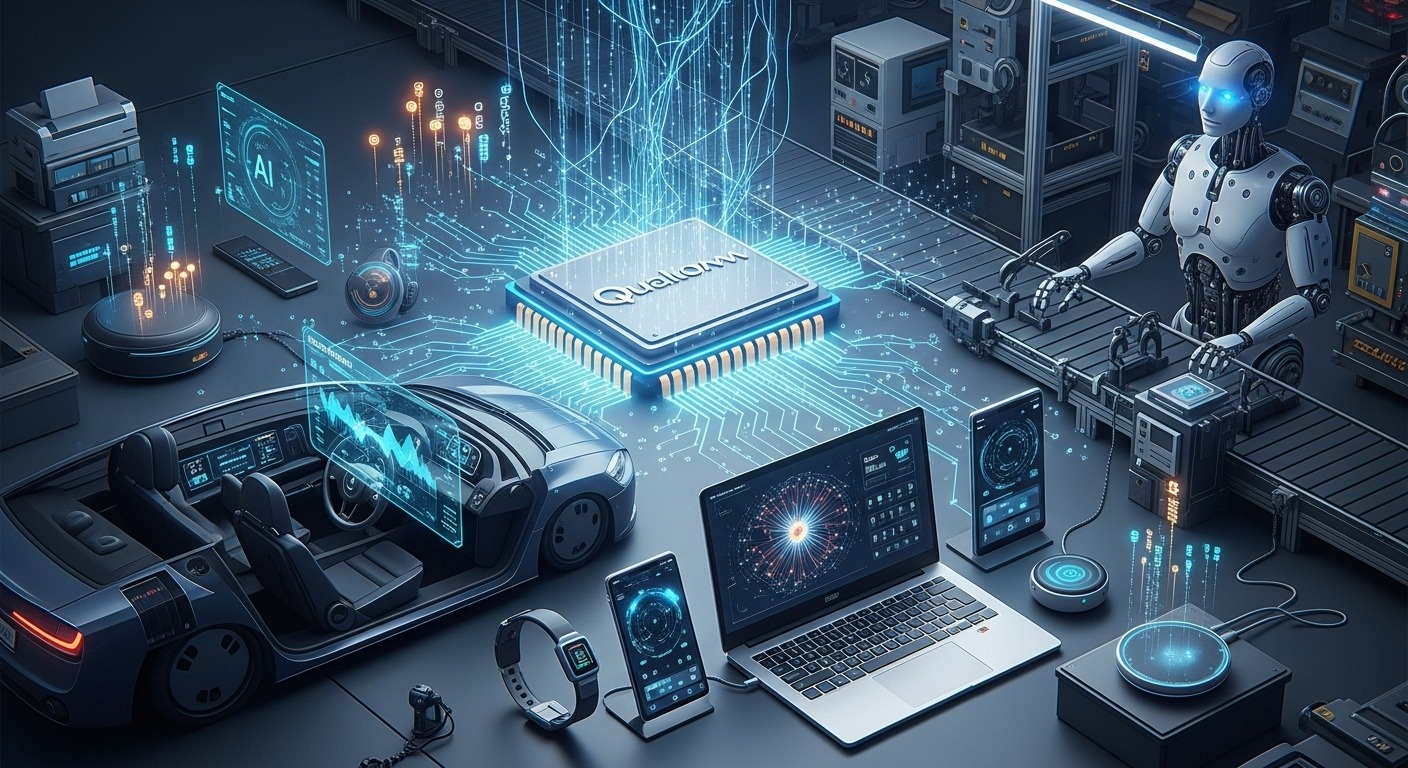
Artificial Intelligence dominated the technology narrative in 2025, driving record gains across the sector and pushing major indexes to new highs. But according to Qualcomm, the story is far from over. In fact, the real transformation may only be beginning. As the world looks ahead to 2026, AI is entering its next phase—moving beyond massive data centers and into everyday devices, vehicles, robots, and industrial systems.
That was the central message from Qualcomm President and CEO during a wide-ranging interview, where he described a future in which AI is embedded everywhere, reshaping how people interact with technology and how industries operate.
From AI Infrastructure to AI Everywhere
The first wave of the AI boom focused heavily on cloud infrastructure, hyperscale data centers, and specialized computing hardware. While that phase delivered enormous growth for the tech sector, Qualcomm believes the next stage will be even broader in impact.
According to the International Monetary Fund, accelerating AI adoption is expected to support steady global growth in the years ahead. Qualcomm sees itself at the center of this transition, uniquely positioned to bring AI out of centralized environments and into distributed, edge-based systems.
Unlike many semiconductor companies that specialize narrowly in CPUs or GPUs, Qualcomm operates across a wide spectrum of technologies—from ultra-low-power wearable devices to high-performance data center agents. This versatility allows the company to deploy AI capabilities across industries ranging from mobile and PCs to automotive, robotics, and industrial systems.
A Diversified Semiconductor Powerhouse
Qualcomm’s leadership emphasized that diversification has become one of the company’s greatest strengths. While its heritage in mobile technology remains a point of pride, the company has steadily expanded its portfolio far beyond smartphones.
Qualcomm now offers a comprehensive platform that includes cellular connectivity, Wi-Fi, Bluetooth, advanced computing, and AI acceleration. This broad foundation has enabled the company to enter nearly every sector touched by modern computing—a list that continues to grow as AI adoption accelerates.
At a recent analyst meeting, Wall Street took note. Analysts walked away with the impression that Qualcomm’s product portfolio is expanding rapidly, opening up new growth avenues that did not exist just a few years ago.
Redefining the PC and Computing Landscape
One area where Qualcomm is challenging long-held assumptions is personal computing. Historically, Qualcomm was not viewed as a computing company in the traditional sense. That perception is now changing.
Powered by Snapdragon X processors, Qualcomm has entered the PC market with systems that deliver exceptional performance, energy efficiency, and AI capability. In fact, company leadership noted that some of the fastest laptops currently available are built on Snapdragon platforms.
Speed remains a key demand for users, particularly as AI workloads become more complex. With AI increasingly integrated into everyday software, processing power is no longer a luxury—it is a necessity. Qualcomm argues that no one has ever complained about a processor being too fast, especially in an AI-driven world.
AI as a Strategic and Economic Imperative
Beyond consumer demand, AI has also become a matter of national and economic security. New policy frameworks emphasize international competitiveness, technological sovereignty, and secure supply chains. In this environment, AI is no longer optional—it is strategic.
Qualcomm expects AI to fundamentally redefine software and computing over the next five years. Every device, machine, and system is becoming intelligent, capable of perception, reasoning, and action. This transformation is driving what many describe as a new industrial revolution.
At the center of this shift is AI-powered computing, which enables automation, efficiency, and entirely new business models. Qualcomm sees enormous opportunity in helping industries transition toward smart factories, autonomous systems, and robotics-driven manufacturing.
Robotics and the Future of Manufacturing
One of the more surprising developments has been Qualcomm’s rapid expansion into robotics. The company recently launched its own robotics platform, catching many observers off guard.
But from Qualcomm’s perspective, robotics is a natural extension of its AI and edge-computing expertise. As factories modernize and supply chains become more automated, intelligent robots and smart machines will play a central role.
Autonomous systems, AI-driven robots, and intelligent industrial equipment are expected to redefine manufacturing and logistics. Qualcomm believes its technology stack—combining connectivity, computing, and AI—makes it a critical enabler of this transformation.
The Car as a Computer on Wheels
Perhaps nowhere is AI’s impact more visible than in the automotive sector. Qualcomm is now working with virtually every major automaker as vehicles evolve into “computers on wheels.”
Modern cars are no longer just modes of transportation. They are complex computing platforms equipped with multiple screens, constant cloud connectivity, AI-powered driver assistance, and autonomous driving capabilities.
Qualcomm supplies the semiconductor backbone that powers in-car displays, infotainment systems, connectivity, and AI-driven driving features. As vehicles increasingly drive themselves, drivers gain the ability to work, relax, or be entertained—transforming the driving experience entirely.
Voice-based AI agents play a particularly important role in vehicles. Talking to an AI assistant is a natural interface when driving, making AI-powered agents ideal for navigation, communication, and control inside the car.
A Balanced Revenue Future
Despite its aggressive expansion into new markets, Qualcomm remains realistic about its financial evolution. The company expects handsets to account for roughly 50% of revenue by fiscal 2029, with the remaining half coming from automotive, PCs, industrial IoT, robotics, and other emerging segments.
This balance reflects a deliberate strategy to reduce reliance on any single market while capturing growth across multiple AI-driven industries. Qualcomm has already delivered consistent double-digit growth in areas such as industrial IoT, and management believes this momentum will continue.
Conclusion: Building the AI-Powered World
Qualcomm’s vision for the future is ambitious but clear: AI will not live only in the cloud—it will live everywhere. From laptops and smartphones to cars, factories, and robots, intelligence will be embedded into the fabric of daily life.
As AI reshapes how humans interact with machines, Qualcomm aims to be the technology company that connects, computes, and powers this new world. With diversification, edge-AI leadership, and deep industry partnerships, the company believes it is well positioned for the next chapter of the AI revolution.